THE ARTICULATORY AND ACOUSTIC FEATURES OF RUSSIAN SPEECH SOUNDS
THE VOWELS IN RUSSIAN
THE PHONETIC POSITIONS OF VOWELS
We have pointed out earlier that all languages bujld their sound strings in accordance with some internal language-specific rules.
The elements of the sound string can only be linked with each other if certain restrictions are observed. The combinations of the factors determining sound linkage result in phonetic positions. The phonetic positions of Russian vowels are built of the following factors: a) word stress, b) the phonetic structure of the word, and c) the palatal or palatalized—pharyngealized nature of the neighbouring consonants. Besides the above, the grammatical position may also sometimes interfere, inasmuch as in certain suffixes the standard pronunciation requires a central reduced vowel rather than a palatal reduced one (e.g.: [тог’э, mor'om] etc.).Depending on word stress we can speak about a) stressed syllables, b) unstressed syllables immediately preceding the stressed syllables, and c) other unstressed syllables. All three positions affect the choice of vowels.
According to its place in the phonetic structure of the word the vowel can be in a) .absolute word initial, b) word medial, and c) absolute word final position.
According to the palatalized (“soft”) or non-palatahzed (“hard”) nature of the neighbouring consonants several vowel positions have to be differentiated again: a) environments containing non-palatalized consonants (positions of the type ot, tot, to), b) environments containing palatalized consonants (positions of the type t’ot’), c) positions between a non-palatalized and a palatalized consonant (ot’ and tot’), and d) positions between a palatalized and a non-palatalized consonant (t’o and t’ot).
THE QUALITY AND QUANTITY OF VOWELS
Stress and the structure of the word determines the duration of vowels: a) in stressed position long vowels are used; b) in the syllable immediately preceding the stressed one, in the unstressed, absolute word initial and also in the absolute word final position following a non-palatalized consonant short vowels are used, and the position so defined is called the primary weak position; c) in other unstressed syllables reduced vowels are used, and the position so defined is called the secondary weak position.
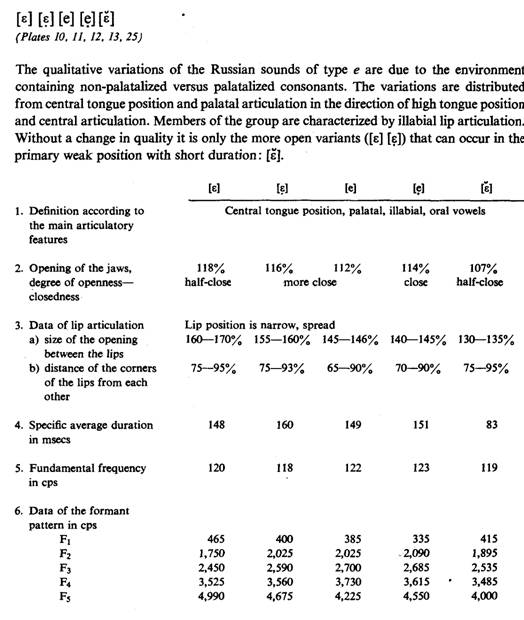
The palatalized-non-palatalized nature of the neighbouring consonants determines the quality of vowels in the sound string. It is a general rule that a palatal or palatalized consonant cannot be followed by a central vowel or by open [є], [є], [e] or by velar vowels unless they contain a “linking” [i]-like sound. If the palatal consonant follows the vowel, there is greater variability especially in unstressed positions. Non-palatalized consonants can be followed by palatal vowels only in foreign words. (Figure 9 shows the varieties of vowels of type о in palatalized and pharyngealized environments as they are revealed by radiograms.)
MONOPHTHONGS, DIPHTHONGOIDS AND TRIPHTHONGOIDS
The analysis of the articulatory and acoustic diagrams of Russian vowels leads us to the conclusion that the Russian vocal system consists of monophthongs, diphthongoids and triphthongoids. Monophthongs occur in isolated pronunciation, in closed syllables containing non-palatalized consonants (in the position type tot), in environments containing vowels and in the overwhelming majority of unstressed positions. At the same time in environments containing palatalized consonants there appears a so-called “linking” sound in the initial and/or final phase of the vowel. We can demonstrate this easily if we copy the spectrum of the reduced [i] on tracing paper and put it over the initial or final section of the spectrum of such sounds as are provided with the diacritic dot in the transcription. This comparison shows unambiguously that the common features of such sounds are the decrease in the frequency of Fi and the bending of the frequency of F2 towards 2,000 cps. These are the indications of the presence of an [i]-like semi-vowel in the spectrum of the sound. My experiments with the speech segmentator also convinced me that it was right to consider these vowels as diphthongoids. We separated the sounds in question from natural sound strings; then, with several repetitions, I made native speakers of Russian and also my students who were native speakers of Hungarian listen to them.
After this I made my informants imitate what they had heard. Apart from the auditive comparison we also made sound spectrograms. The sound so far considered as unpronounceable in isolation now became a sound element correctly pronounceable and “teachable”.The stressed, absolute word initial position and the absolute word final position following a non-palatalized consonant are also favourable for diphthongoid pronunciation ([и60гЧгл], [лкпи6»]). This is apparent especially in emphatic conversational speech. Here, however, the semi-vowel we hear is of a velar colouring. I am planning to give a more detailed analysis of this phenomenon in another publication [Magyar Fonetikai Fiizetek (Hungarian Papers in Phonetics) 4. 1979.].
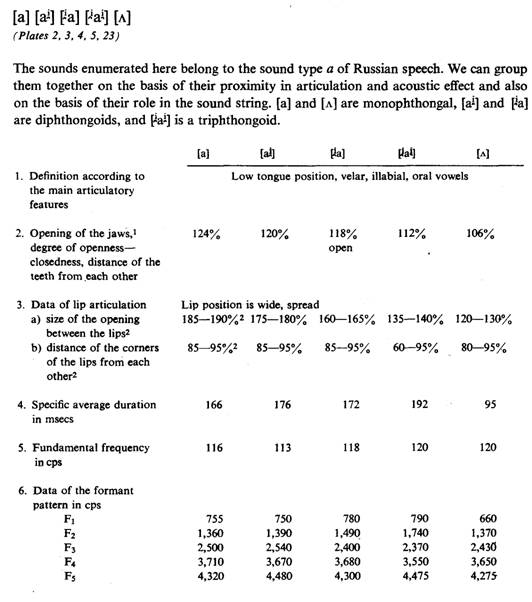
According to the direction of tongue movement we divide diphthongoids into closing [а*], [0і], [u-] and opening ['a], [-0], [-u] ones. Triphthongoids are opening—closing ones: [iai], M, m
Diphthongoids and triphthongoids can also be grouped according to the ratio of their sound elements. If diphthongoids begin with a quickly changing, so-called linking semivowel, which in turn is followed by a more stable nucleus, they can be called strengthening (rising), and in the reserve case weakening (falling) diphthongoids. Triphthongoids are strengthening-weakening.
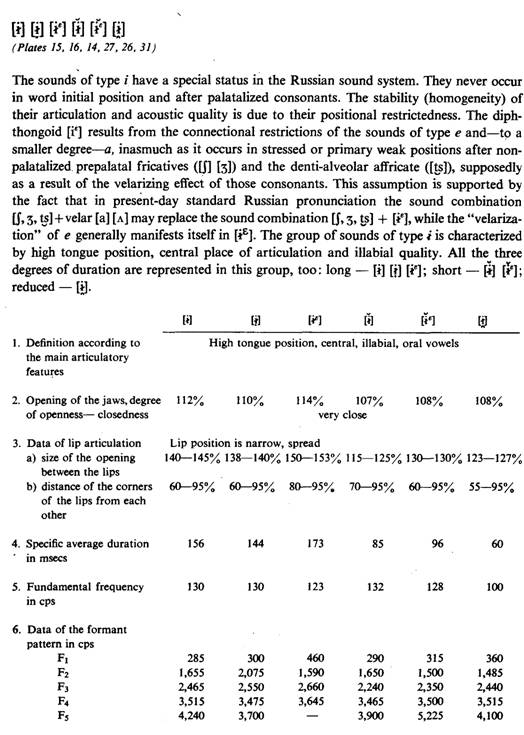
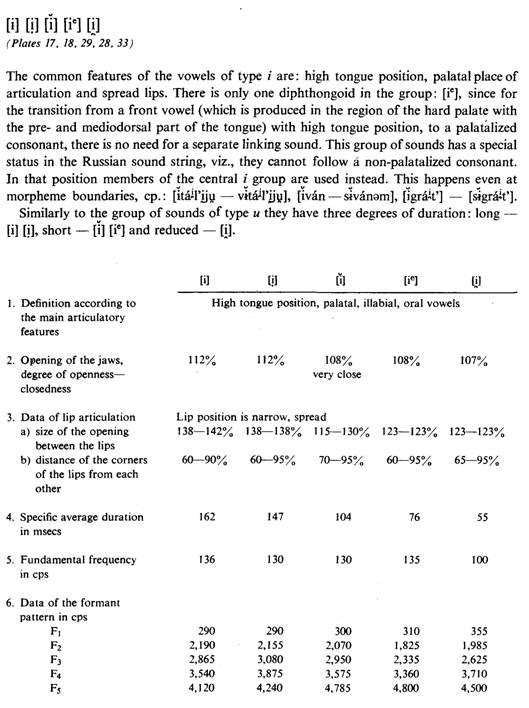
All Russian vowels are of oral articulation. According to the place of articulation they fall into three groups: a) front (palatal), b) central (medial), and c) back (velar). According to the position of the tongue we also distinguish three types: vowels with a) low, b) central, and c) high tongue position. As to lip articulation, both basic shapes: the spread and the rounded lip positions are present in the Russian vowel system. The proportion of illabial vowels is considerably larger in the system; labial ones can only be found among velars. Diphthongoids are found primarily among long (stressed) velar vowels, although we can find diphthongoids also in the palatal and central group of vowels of higher than central tongue position ([i'J [T]).
The system is basically determined by two factors: a) (the palatalized or non-palatalized character of) the consonantal environment, which determines sound quality, and b) stress, on which quantity (duration) depends. The position of the vowel in relation to the stressed syllable of the word (and in connection with this, the position of the vowel within the structure of the word) determines where in the sound string the vowel is long, short or reduced.
We show the system of Russian vowels in a table representing articulatory features and duration. (See Plate 1 and also Figure 10.)
Table I.
The Russian Vovel System
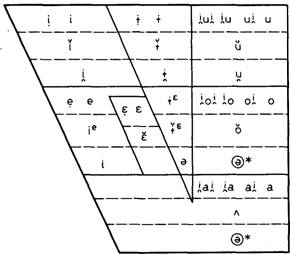
[1] 100% represents the rest position (i.e. when the lips are closed as in the state of rest), as reference value for evaluation of all other data.
[1] The first number represents the distance of the outer measurement points, the second the distance, of the inner edges of the lips from each other.
[о] и N № [б]
(Plates 6, 7, 8, 9, 24)
Vowels of type о share the following features: central tongue position, velar place of articulation and labial quality. Deviations within the group are due to differences in phonetic position. Those in a stressed position may be twice as long in duration as [6]. The latter has a rather limited occurrence, as it is used only in unstressed function words and foreign words. The varieties marked with diacritic dots are sound elements used for a smooth transition between velar vowels and palatalized or palatal consonants. The vowel is connected with the consonant or the consonant with the vowel by means of an [i]-like linking sound. As a consequence, the vowel receives a diphthongoid or triphthongoid character.

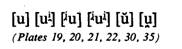
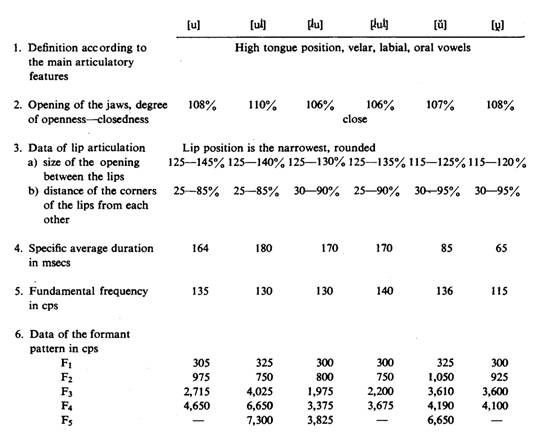
The above sounds are grouped together on the basis of the following common features: high tongue position, velar place of articulation and labial quality. When their environment contains palatal or palatalized consonants, transition takes place by means of a palatal linking sound, the same process as we see in the groups of types a and o. The characteristics determining their quality are preserved even in positions causing reduction.
/
Еще по теме THE ARTICULATORY AND ACOUSTIC FEATURES OF RUSSIAN SPEECH SOUNDS:
- THE PHONETIC TRANSCRIPTION OF RUSSIAN SPEECH SOUNDS
- THE SOUND PLATES OF RUSSIAN SPEECH SOUNDS
- THE CONSONANTS IN RUSSIAN
- THE MEANS AND METHODS OF SPEECH EXAMINATION
- LANGUAGE AND SPEECH
- FOREWORD
- CONTENTS
- ИСПОЛЬЗОВАННАЯ ЛИТЕРАТУРА
- ЛИТЕРАТУРА
- РИСУНКИ
- Т.В. Тучкова Гуманитарный факультет МГТУ, кафедра психологии ипедагогики
- Использованная литература
- С.Г. Лутонина Аспирантка МГТУ, кафедра философии
- Н.Н. Забелина Гуманитарный факультет МГТУ, кафедра философии
- SUMMARY
- Литература
- Мужское тело и современная массовая культура