THE CONSONANTS IN RUSSIAN
THE PHONETIC POSITIONS OF CONSONANTS
The occurrence and possible connections of consonants in the sound string are restricted by fewer factors than those of vowels. The less restricted occurrence and variation of consonants is due to the consonantal character of present-day Russian.
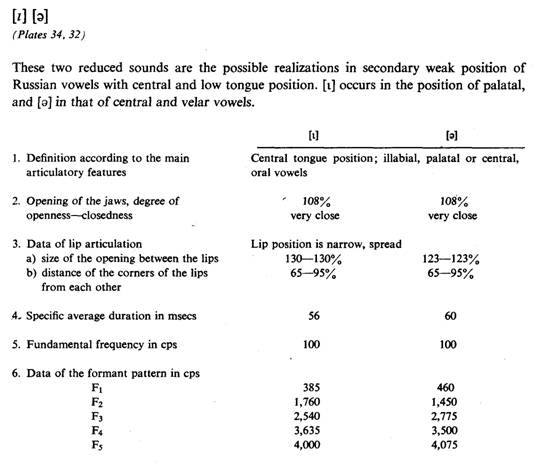
The restriction covering the whole system concerns two features: voice—voicelessness on the one hand and palatalization (“softness”)—non-palatalization (“hardness”) on the other. Peripherally, a few sounds can undergo lengthening (a change in quantity) as well. We know four phonetic positions in which consonants are restricted in their above features,a) In an absolute word final position there cannot occur a voiced consonant in Russian.

/
b) In word initial and word medial consonant combinations it is the quality of the second consonant that determines whether the preceding consonant is voiced or voiceless and whether it is non-palatalized or palatalized.
We speak about voiceless position if, because of the voicelessness of the second consonant the first one can also only be voiceless. Sonants again behave in two ways: in most cases they preserve their voice, in some cases they become voiceless. (Cp.: [jfijpkv, totkv, f’s-o, skdskx; rta, mxa, pvrtr’et].)
The position is called voiced if, because of the voicedness of the second consonant the preceding one can also be only voiced. An exception is the case where the second sound is a sonant or a voiced, labiodental fricative, since these do not require the voicedness of the preceding consonant. (Cp.: [zda4\ proiz’bA, vAgzal; trAva, s’v’et, srok, s’n’ek, kvas, mAskva, smAtr’et’].)
If the palatalized quality of the second consonant causes the palatalization of the preceding consonant, we speak about palatalized position.
(If the second consonant is non- palatalized, it can be preceded by both non-palatalized and palatalized consonants.) (Cp.: [d’n’iom, v’iVn’e; tolk, toil’kA, prostA, proiz’bA].)c) Morpheme boundaries constitute a special situation for consonants. The voicing which takes place at morpheme boundaries is responsible for such marginal elements of the Russian consonant system as [dz] [d3] [%] [у]. (Cp.: [kAn’edzgodA, nod3’bil&, ZASoybj, moxxor].) Coalescent lengthening also occurs at morpheme boundaries. (Cp.: [3 :ait’, v:Ad’6, Ad:aj,t’].)
d) The palatalization of velar consonants before affixes containing a palatal vowel is an extension of the opposition, non-palatalized palatalization, to morpheme boundaries. (Cp.: [riik’i, nAg’d, sax’]].)
The position of consonants before palatal vowels, in which the consonant can only be palatal or palatalized, is the result of historical development. (The non-palatalized pronunciation of consonants in this position, which can be found in foreign words, is an exception.) (Cp.: [p’it’, p’et’, t’igr; б tel] dtndi].)
PALATALIZATION AND PHARYNGEALIZATION
The non-palatalized-palatalized opposition, which is relevant to the whole system of Russian consonants is based on the secondary articulations: palatalization and pharyngeal- ization. As to the phonetic nature of palatalization we find full agreement among different authors in the phonetic literature. (Palatalization is a secondary articulatory movement of the dorsum towards the hard palate, which brings about a decrease in the size of the frontal resonating chamber of the vocal tract, while increasing the space near the pharynx.) As concerns pharyngealization, however, Russian phonetic literature would rather identify it as velarization. Nevertheless, my radiographic investigations have convinced me that pharyngealization is a more suitable term because I have found the movement of the root of the tongue and the postdorsum towards the pharyngeal wall to be more important than that towards the soft palate.
This phenomenon occurs with a considerable constriction of the resonating chamber near the pharynx, while the size of the front part of the oral cavity is increased. (See Figure 11.)According to the movements of the tip of the tongue we distinguish three types of articulation: apical, cacuminal and retroflex. Consonants produced by raising and retracting the tongue-tip raised and retracted are absent in Russian. Besides the apical [1], [I’],.[r], [r’] I have established a mixed type called apicopredorsal for the sounds [t] and [d],
PECULIARITIES OF THE NARROWING
There are two articulatory features which deserve more attention and further study: the rounded or spread shape, and the unifocal or bifocal character (i.e. whether or not there is a concavity in the mediodorsum) of the narrowing. The shape of the narrowing across the medial line of the vocal tract is fundamentally determined by the articulation of the tongue-rims. This can be well observed in the palatograms and linguograms. This is why I have established the separate distinctive feature: coronal-non-coronal articulation.
TYPES OF CONFIGURATIONS OF ARTICULATORY ORGANS
The configuration of articulatory organs, which is characteristic of the chief articulatory phase, has a decisive role in the production of the noise element of consonants. Generalizing, we can say that a passive and an active organ (the lower lip and the tongue) form a kind of obstruction in the passage of the issuing air. This is what determines the manner and place of articulation, i.e. the quality of the consonant. For the sake of pronunciation teaching I have made a separate list of the types of articulatory configurations whereby Russian consonants can be produced:
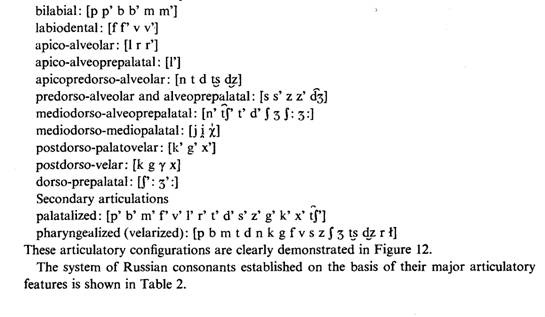
Table 2
The Russian Consonant System

We intend to examine these from the following points of view:
1.
Position of the vocal cords and participation of the larynx in articulation.2. Position of the uvula and its effect on sound quality.
3. Manner of articulation and description of the sound according to the manner of articulation.
4. Place of articulation in terms of the organ with which the tongue forms a configuration, and description of the sound according to the place of articulation.
5. Place of articulation in terms of various parts of the tongue, description of the sound
according to the part of the tongue that rises in the articulation. \
6. The role of the tongue-rims in articulation.
7. Type of configuration of the articulatory organs.
8. Secondary articulatory phases (palatalization and velarization = pharyngealization).
9. Position of the lips and the jaws
a) opening of the upper and lower lips
b) distance of the corners of the lips from each other
c) opening of the lower jaw
d) horizontal movement of the lower jaw.
10. Specific average duration of the sound.
11. Oscillogram of the sound.
12. Description of the sound spectrogram.
[Pi
(Plate 36) [5]
c) The lower jaw opens by 8 %.
d) The lower jaw does not move horizontally.
TO. Specific average duration: 116 msecs.
11. Its oscillogram consists of the basic line corresponding to the silent phase, and the trace of a noise, 4-6 msecs long, corresponding to the plosion phase.
12. In its spectrogram the phase without components is followed by the narrow stripe of the plosion noise. Fi — 400 cps, F2 — 1,000 cps, F3 — 1,500 cps.
[P’]
(Plate 37)
1. The vocal cords are in a position for breath, the air stream reaches the vocal tract without obstruction. The consonant is voiceless.
2. The uvula blocks the opening of the nasal cavity; an oral sound.
3. The consonant is produced by the noise of the plosion, the closure blocking the air stream. Plosive.
4. The place of articulation is at the contact area of the upper and lower lips; a bilabial plosive.
5. The tongue does not have a decisive role in the chief articulatory phase.
6. The rims of the tongue do not have a separate articulatory function.
7. The articulatory configuration determining sound quality consists of the bilabial closure.
8. It is palatalized, i.e. the body of the tongue moves forward within the oral cavity and its dorsal part approaches the palate. Thus it brings about a considerable decrease in the volume of the front part and an increase in the volume of the back part of the resonating chamber.
9. a) The lips show a contraction of 10-15% at the outer measurement points.
b) The distance between the corners of the lips does not change.
c) The lower jaw opens by 8 %.
d) The lower jaw does not move horizontally.
10. Specific average duration: 170 msecs.
11. In its oscillogram the basic line indicates the silent phase, while the plosion noise is indicated by deflections of weak intensity for a period of about 20 msecs. The extra length of this period is due to palatalization.
12. In its spectrogram, after the silent phase we can find weak noise components in the following frequencies: Fj — 300 cps, F2 — 2,000 cps, F3 — 2,600 cps, F4 — 4,200 cps.
[b]
(Plate 38) [6]
3. The jaws and the teeth move away from each other while the lips are closed. In consequence of the pressure of the air column the bilabial closure bursts open and noise is produced. Plosive.
4. The place of articulation is at the contact area of the lips; a bilabial consonant.
5. The tongue does not play an active articulatory role; its position approximates that of the rest position.
6. The rims of the tongue do not play an active role.
7. The articulatory configuration producing the noise element of the consonant consists of the bilabial closure.
8. Its radiogram shows moderate pharyngealization, i.e. the root of the tongue approaches the wall of the pharynx and there is a slight concavity in the mediodorsal part of the tongue.
9. a) The lips show a contraction of about 7-8% as compared to the rest
position.
b) The position of the corners of the lips does not change significantly as compared to the rest position.
c) The lower jaw opens by 10%.
d) The lower jaw does not move horizontally.
10. Specific average duration: 120 msecs.
11. In its oscillogram the voice produces a regular sinusoid wave of low intensity, in the final stage of which the release of the closure is indicated by a mild surge. Its fundamental frequency is 95 cps.
12. Its spectrogram is very poor in components. Besides the fundamental frequency it contains only a plosion noise of low intensity, which usually appears in a line-like stripe around 750-950 cps in the spectrogram.
[b’l
( Plate 39) [7]
b) The position of the corners of the lips does not change significantly as compared with the rest position.
c) The lower jaw opens by 12%.
d) The lower jaw does not move horizontally.
10. Specific average duration: 140 msecs.
11. Its oscillographic curve is the same in character as that of its non-palatalized counterpart. The frequency of the voice is 100 cps.
12. In its spectrogram, besides the voice,' the noise component increased by palatalization is shown more intensively than in the case of its non-palatalized counterpart. F3 — 250- 300 cps, F2 — 1,800 cps, F3 — 2,500 cps, F4 — 3,450 cps.
[t]
(Plate 40)
1. The vocal cords are in a position for breath; voice is not produced in the larynx; the consonant is voiceless.
2. The uvula blocks the opening of the nasal cavity; an oral sound.
3. A closure is formed in the central zone of the oral cavity, which bursts open in consequence of the pressure of the air column, and the noise of that burst constitutes the noise element of the sound. Plosive.
4. The closure is formed in the region of the teeth and the alveolum; a dentialveolar consonant.
5. It is apicopredorsal, i.e. the closure is formed with the tip and the front of the tongue.
6. The rims of the tongue are in contact with the palate along the inner sides of the teeth in a stripe tapering off backwards; a coronal sound.
7. It is apicopredorso-dentialveolar, i.e. the closure is made between the front of the tongue including its tip, and the region of the teeth and the alveolum, along the medial line of the vocal tract.
8. It is pharyngealized, i.e. the postdorsum and root of the tongue approaches the wall of the pharynx. The concavity in the predorsum also increases the resonating space in the front part of the oral cavity.
9. a) The lower and upper lips open by 30%.
b) The inner distance between the corners of the lips is narrowed by 20%.
c) The lower jaw opens by 10%.
d) It does not move significantly on the horizontal plane as compared to rest position.
10. Specific average duration: 134 msecs.
11. Its oscillogram shows only weak plosion for 8-Ю msecs.
12. In its spectrogram the plosion is indicated by a narrow stripe of noise which has a wide frequency band (extending almost to 7,000 cps). The closure phase is acoustically blank.
[f]
(Plate 41)
1. The vocal cords are in a position for breath; voice is not produced in the larynx; the consonant is voiceless.
2. The uvula blocks the opening of the nasal cavity; an oraI sound.
3. A closure is formed in the central zone of the oral cavity, which bursts open in consequence of the pressure of the air column, and the noise of that burst constitutes the noise element of the sound. Plosive.
4. The closure is formed in the region of the teeth and the alveolum; a dentialveolar consonant.
5. The closure is made with the front of the tongue, it is predorsal.
6. The rims of the tongue are in contact with the teeth and the palate in a wider stripe along the inner sides of the teeth; a coronal sound.
7. It is predorso-dentialveolar, i.e. the closure is formed between the front of the tongue and the region of the teeth and the alveolum, along the medial line of the vocal tract.
8. It is palatalized, i.e. the body of the tongue moves forward in the oral cavity and rises towards the palate.
9. a) The lips open by 20%.
b) The inner distance between the corners of the lips is narrowed by 20-25 %.
c) The lower jaw opens by 8%.
d) The lower jaw does not move significantly on the horizontal plane as compared to the rest position.
10. Specific average duration: 190 msecs.
11. Its oscillogram contains a “brush-like”, linear tracery continuing for about 96-100 msecs, which can be attributed to friction noise.
12. In its spectrogram the second phase of articulation is represented by a noise component which is present almost in the entire frequency band but is most intensive between 4,200 and 6,800 cps. Fairly intensive noise components can also often be found around 2,000 and 3,500 cps.
[d]
( Plate 42) [8]
5. The closure is formed with the tip and front of the tongue; it is apicopredorsal.
6. The rims of the tongue are in contact with the palate along the inner sides of the teeth in a stripe tapering off backwards; a coronal sound.
7. It is apicopredorso-dentialveolar, i.e. the closure is made between the front of the tongue including its tip and the region of the teeth together with the alveolum, along the medial line of the vocal tract.
8. It is pharyngealized, i.e. the postdorsum and root of the tongue approaches the wall of the pharynx. The concavity in the predorsum also increases the resonating space in the front part of the oral cavity.
9. a) The lower and upper lips open by 30 %.
b) The inner distance between the corners of the lips is narrowed by 30%.
c) The lower jaw opens by about 10%.
d) The lower jaw is retracted by about 7%.
10. Specific average duration: 102 msecs.
11. In its oscillogram we can find a sinusoid voice curve in the closure phase and a weak stripe of noise in the plosion phase. The frequency of the voice is 115 cps.
12. Its spectral pattern contains rather weak components at the following frequencies: Fj — 250 cps, F2 — 900 cps, F3 — 1,500 cps, F4 — 2,300 cps, F5 — 3,500 cps.
Ю.
(Plate 43) [9]
11. Its oscillogram contains a voice curve of low intensity, which is completed in the plosion phase by a “fuzzy” tracery caused by friction noise, lasting for a relatively long period of 50 msecs. The frequency of the voice is 102 cps.
12. Its spectrogram is composed of voice and noise which is jointly caused by plosion and friction. Being palatalized, its noise component extends to higher frequencies, too. Fi — 200 cps, F2 — 1,900 cps, F3 — 2,800 cps, F4 — 3,800 cps, F5 — 5,000 cps.
M
( Plate 44)
1. The vocal cords are in a position for breath; voice is not produced in the larynx: the consonant is voiceless.
2. The uvula blocks the opening of the nasal cavity; an oral sound.
3. A closure is formed in the back part of the oral cavity and the noise of its plosion constitutes the sound. Plosive.
4. The closure is formed at the front part of the soft palate; a velar consonant.
5. It is postdorsal, i.e. the back of the tongue is in contact with the soft palate.
6. The rims of the tongue do not play a role in modifying sound quality.
7. It is postdorso-velar, i.e. the articulatory configuration producing the noise consists of the back of the tongue and the front of the soft palate.
8. It is mildly pharyngealized. The postdorso-velar closure bisects, as it were, the oral resonator.
9. a) The lower and upper lips open by 30-40%.
b) The distance between the corners of the lips is narrowed to 80-95 % of that in the rest position.
c) The lower jaw opens by 10 to 12%.
d) The lower jaw is retracted by 10 % on the horizontal plane.
10. Specific average duration: 169 msecs.
11. Its oscillogram is characterized by the basic line in the closure phase and a short, low intensity deflection in the plosion phase.
12. Its spectrogram consists of two parts: a pause indicating the absence of phonation and a hair’s breadth thin stripe of noise, which has higher intensity between 1,200 and 1,700 cps, lower intensity around 500 cps and between 5,000 and 7,000 cps.
[k’]
(Plate 45) [10]
4. The closure is formed in the palatovelar region of the vocal tract; a palatovelar consonant.
5. It is postdorsal, i.e. the closure is formed with the back of the tongue.
6. The rims of the tongue do not play an active role in articulation.
7. Postdorso-palat'ovelar.
8. It is mildly palatalized. The postdorso-palatovelar closure divides the oral cavity into two parts, of which the back one is markedly bigger in volume.
9. a) The lower and upper lips open by 30%.
b) The distance between the corners of the lips is narrowed to 75-90% of that in the rest position.
c) The lower jaw opens by 10%.
d) The lower jaw is slightly retracted (by 6-7 %) on the horizontal plane.
10. Specific average duration: 184 msecs.
11. Its oscillogram is characterized by fine linear tracing at a longer section of the basic line, in the plosion phase.
12. Its spectrogram is characterized by a wider (50-60 msecs) stripe of noise due to palatalization. The stripe extends between 2,400 and 5,500 cps and contains energy peaks around 3,500, 4,200 and 5,000 cps.
[g]
(Plate 46 ) [11] [12]
12. Its spectrogram contains voice and short plosion noise. In its poorly outlined formant pattern components can be found at the following frequencies: Fj — 250 cps, F2 — 1,500 cps, F3 — 2,000 cps, F4 — 5,000 cps, F5 — 7,000 cps.
[g’l
(Plate 47)
1. The vocal cords are in a position for voice; voice is produced in the larynx; the consonant is voiced.
2. The uvula blocks the opening of the nasal cavity: an oral sound.
3. A closure is formed in the back part of the oral cavity and the noise of its plosion constitutes the sound. Plosive.
4. The closure is formed near the dividing line between the hard palate and the soft palate; a palatovelar consonant.
5. The closure is formed between the back of the tongue and the postpalatal-prevelar region; it is postdorsal.
6. The rims of the tongue do not play an active role in articulation.
7. It is postdorso-palatovelar, i.e. the noise is brought about by the configuration of the postdorsum and the border region of the palate and the velum.
8. It is mildly palatalized, i.e. the body of the tongue moves further forward in the oral cavity than in the case of the non-palatized counterpart of the sound, and thus the volume of the glottal resonator is increased while the front part of the oral cavity is not decreased in volume to such a degree as in the case of strongly palatalized consonants.
9. a) The lips open by 25-30%.
b) The distance between the corners of the lips is narrowed to 80-95 % of that in the rest position.
c) The lower jaw opens by 8 %.
d) The lower jaw is somewhat retracted (by 7 %) on the horizontal plane.
10. Specific average duration: 160 msecs.
11. Its oscillogram contains a “brush-like” tracery of aspirated noise due to palatalization following a voice curve of low amplitude. The frequency of the voice is 95 cps.
12. In its spectrogram both the voice and the noise elements show more intensively than in the case of the non-palatalized counterpart of the sound. Fj — 200 cps, F2 — 2,700 cps, F3 — 3,200 cps, F4 — 3,700 cps, F5 — 4,200 and 4,650 cps.
[m] [m]
(Plate 48) [13]
2. The uvula opens the way'to the nasal cavity and the air stream passes through it; a nasal sound.
3. A closure is formed by the compression of the lips but there is no plosion because the air can escape freely through the nasal cavity. The sonant is formed from the voice by the joint resonance of the pharyngeal, nasal and oral cavities. In the case of its voiceless counterpart the sound is produced by blowing the air through the resonating system. It is a nasal (occlusive) consonant.
4. The tongue does not form a configuration determining sound quality with a passive articulatory organ.
5. The position of the tongue does not alfect sound quality.
6. Palatograms and linguograms show a slight contact of the rims of the tongue.
7. Bilabial closure.
8. It is pharyngealized, i.e. the body of the tongue moves towards the wall of the pharynx thus increasing the volume of the front part of the oral cavity.
9. a) Instead of opening, the lips are compressed by about 20%.
b) Because of the opening of the lower jaw the corners of the lips come closer to each other by about 5-10%.
c) The lower jaw opens by 8-10%.
d) The lower jaw is somewhat retracted on the horizontal plane.
10. Specific average duration: 97 msecs.
11. Its oscillogram shows a curve attributable to periodic vibrations similar to that of vowels, but with a somewhat lower amplitude than in their case. Its fundamental frequency is 110 cps.
12. In its spectrogram we can see a moderately indented formant pattern, which is clearer in the low frequencies. Fj — 200-300 cps, F2 — 1,000-1,200 cps, F3 — 2,600 cps, F4 — 3,800 cps.
[m’]
(Plate 49) [14]
8. It is palatalized, i.e. the body of the tongue moves forward in the oral cavity and its dorsum approaches the palate.
9. a) The lower and upper lips are slightly compressed (by about 6-8 %).
b) The distance between the corners of the lips is the same as in the rest position.
c) The lower jaw opens by 8-10%.
d) It is somewhat retracted on the horizontal plane.
10. Specific average duration: 97 msecs.
11. Its oscillographic curve is of a simple pattern with a lower amplitude than in the case of vowels. The frequency of the voice is 108 cps.
12. Its spectrogram shows a well-marked formant pattern. F! — 200-300 cps, F2 — 1,000 cps, F3 — 2,150 cps, F4 — 4,000 cps.
[n]
(Plate 50)
1. The vocal cords are in a position for voice; voice is produced in the larynx; the consonant is voiced.
2. The uvula opens the way to the nasal cavity and the issuing air passes through the nose; a nasal sound.
3. A closure is formed ine th central zone of the oral cavity, and is maintained during the entire process of articulation. The quality of the consonant is due to the dential- veolar closure, and the resonance of the pharyngeal, nasal and oral cavities. It is a nasal (occlusive) consonant.
4. The closure is formed in the region of the teeth and the alveolum; a dentialveolar consonant.
5. The closure is formed with front of the tongue; it is predorsal.
6. The rims of the tongue are in contact with the inner sides of the teeth; a coronal sound.
7. It is predorso-dentialveolar, i.e. the closure is formed between the front of the tongue and the region of the teeth and the alveolum, along the medial line of the vocal tract.
8. It is pharyngealized, i.e. the back and root of the tongue approaches the wall of the pharynx. The resonating space in the front of the oral cavity is also increased by the concavity in the predorsum.
9. a) The lips open by 40-45%.
b) The distance between the corners of the lips is 80%.
c) The lower jaw opens by 14%.
d) The lower jaw is somewhat retracted on the horizontal plane (by 7 %).
10. Specific average duration: 105 msecs.
11. Its oscillographic curve is of a simple pattern, similar to that of vowels, but with a lower amplitude than in their case. The frequency of the voice is 100 cps.
12. Its spectrogram shows a well-marked formant pattern. Fi — 200-300 cps, F2 — 1,200 cps, F3 — 2,600 cps, F4 — 3,600 cps, F5 — 6,500 cps.
[n’]
( Plate 51)
1. The vocal cords are in a position for voice; voice is produced in the larynx; the consonant is voiced.
2. The uvula opens the way to the nasal cavity and the air passes through the nose; a nasal sound.
3. A closure is formed in the central zone of the oral cavity, and is maintained during the entire process of articulation. The quality of the consonant is due to the alveo- palatal closure, and the resonances of the pharyngeal, nasal and oral cavities. It is a nasal (occlusive) consonant.
4. It is alveoprepalatal, i.e. the closure is formed at the alveolum and the front part of the palate.
5. It is mediodorsal, i.e. the closure is formed with the mediodorsum of the tongue.
6. The rims of the tongue are in contact with the teeth; a coronal sound.
7. Mediodorso-alveoprepalatal.
8. It is characterized by a stronger degree of palatalization.
9. a) The lips open by 40-45 %.
b) The distance between the corners of the lips is 70%.
c) The lower jaw opens by 13%.
d) It is retracted by 7 % on the horizontal plane.
10. Specific average duration: 98 msecs.
11. Its oscillogram contains a voice curve with medium amplitude, characteristic of sonants. The frequency of the voice is 110 cps.
12. Its spectrogram shows a well-marked formant pattern. Fj — 250-350 cps, F2 — 1,100 cps, F3 — 2,150 cps, F4 — 3,000 cps, F5 — 3,750 cps.
[f]
(Plate 52) [15]
7. The narrowing is labiodental.
8. It is strongly pharyngealized. The root of the tongue is very near to the wall of the pharynx; the concavity in the mediodorsal part of the tongue shapes the oral cavity into the inverse of the shape for palatalization.
9. a) The lips at the outer measurement points are closed 15% more tightly than in the
rest position, while between the inner edges a narrow gap is formed.
b) The distance between the corners of the lips is narrowed to 70-95 % of that in the rest position.
c) The lower jaw opens by 6%.
d) It is retracted by 20% on the horizontal plane.
10. Specific average duration: 128 msecs.
11. The fine linear tracing of the basic line in its oscillogram indicates the^ friction noise.
12. Its spectrogram consists of a rather intensive, continuous, wide component between 1,000 and 3,000 cps, and a weak, thin component between 3,000 and 4,000 cps.
[f]
(Plate 53)'
1. The vocal cords are in a position for breath; voice is not produced in the larynx; the consonant is voiceless.
2. The uvula blocks the opening of the nasal cavity, the air passes through the oral cavity; an oral sound.
3. The sound is produced by the friction noise of the air passing through a narrowing between the upper incisors and the lower lip. Fricative.
4. It is dental, i.e. the passive organs involved in the articulation are the upper incisors.
5. It is labial, i.e. the active organ of articulation is the lower lip.
6. The rims of the tongue do not play an active role in affecting sound quality. The dorsum forms a narrow gap.
1. The narrowing is labiodental.
8. It is palatalized. The body of the tongue moves forward in the oral cavity, the dorsum approaches the prepalatum, considerably increasing the resonating space in the back.
9. a) With the narrowing of the lips the outer measurement points come closer to each
other, still leaving a narrow gap between the irf?er edges.
b) The distance between the corners of the lips is 80-95 %.
c) The lower jaw opens by 6-7 %.
d) It is retracted by 10-15 % on the horizontal plane as compared to the rest position.
10. Specific average duration: 130 msecs.
11. In its oscillogram fine linear tracery indicates the friction noise increased by palatalization.
12. In its spectrogram the extent and intensity of the noise component is increased. In its continuous stripe of noise there are several energy peaks. Fj — 200 cps, F2 — 2,500 cps, F3 — 3,200 cps, F4 — 3,900 cps, F5 — 6,600-7,500 cps.
[V]
(Plate 54)
1. The vocal cords are in a position for voice; voice is produced in the larynx; the consonant is voiced.
2. The uvula blocks the opening of the nasal cavity, the air passes through the oral cavity; an oral sound.
3. The consonantal component of the sound is produced by the friction noise of the air passing through a narrowing between the upper incisors and the lower lip. Fricative.
4. The passive organs involved in the articulation are the upper incisors; a dental consonant.
5. It is labial. The active organ playing the chief role in the articulation is the lower lip, the inner edge of which is made to vibrate slightly by the frictionally issuing air.
6. The rims of the tongue do not play an active role in the articulation.
7. The narrowing is labiodental.
8. It is pharyngealized, i.e. the root of the tongue gets near to the wall of the pharynx.
9. a) With the narrowing of the lips the outer measurement points come closer to each
other by 7 %, while between the inner edges a narrow gap is formed.
b) The distance between the outer corners of the lips is somewhat smaller, that between the inner corners is narrowed to 65% of that in the rest position.
c) The lower jaw opens by 2-6%.
d) The horizontal retraction of the lower jaw is about 20%.
Ш. Specific average duration: 115 msecs.
11. Its oscillographic curve is the result of the voice component of 95 cps and the noises of higher frequencies.
12. Its spectrogram contains low intensity components at the following frequencies: Fi — 300 cps, F2 — 850 cps, F3 — 2,500 cps, F4 — 3,300 cps, F5 — 4,000 cps.
[V’]
(Plate 55) [16]
8. It is palatalized, i.e. the dorsum gets near to the palatum and with the body of the tongue moving forward the volume of the back part of the oral cavity is increased.
9. a) The distance between the upper and lower lips is a little bigger than that in the case
of non-palatalized [v].
b) The contraction of the distance between the corners of the lips is the same as in the case of [v].
c) The lower jaw opens by 6-8 %.
d) The horizontal retraction of the lower jaw is 20 % as compared to the rest position.
10. Specific average duration: 125 msecs.
11. Its oscillographic curve of low amplitude is the result of the voice component of 100 cps and the friction noise.
12. Its spectrogram consists of low intensity formants. Fi — 350 cps, F2 — 1,800 cps, F3 — 2,250 cps, F4 — 3,500 cps, F5 — 4,150 cps.
[S]
(Plate 56)
1. The vocal cords are in a position for breath; voice is not produced in the larynx; the consonant is voiceless.
2. The uvula blocks the opening of the nasal cavity, the air passes through the oral cavity; an oral sound.
3. A narrowing is formed in the central zone of the front part of the oral cavity between the tongue and the region of the upper incisors together with the alveolum. The sound is produced by the friction noise of the issuing air. Fricative.
4. A dentialveolar consonant.
5. It is predorsal, i.e. the narrowing is formed with the front of the tongue.
6. The rims of the tongue make contact with the teeth and a round gap is formed across the medial line of the tongue; a coronal sound produced with a round gap over the dorsum.
7. It is predorso-dentialveolar, i.e. it is produced by a configuration of the front of the tongue and the dentialveolar zone.
8. It is mildly pharyngealized. There is a concavity in the mediodorsum.
9. a) The lips open by 35-40%.
b) The distance between the corners of the lips is 80-100%.
c) The lower jaw opens by 10-12%.
d) It is about 7% more forward horizontally than in the rest position.
10. Specific average duration: 195 msecs.
11. The “brush-like” linear tracery in its oscillogram shows that the sound consists of high frequency frictional noise.
12. Its spectrogram is characterized by a wide, continuous band of noise above 4,000 cps, with energy peaks between 5,000 and 6,000 cps.
[S’]
(Plate 57)
1. The vocal cords are in a position for breath; voice is not produced in the larynx; the consonant is voiceless.
2. The uvula blocks the opening of the nasal cavity, the air passes through the oral cavity; an oral sound.
3. A narrowing is formed in the central zone of the front part of the oral cavity between the tongue and the region of the upper incisors together with the alveolum. The sound is produced by the friction noise of the issuing air. Fricative.
4. An alveolar consonant.
5. It is predorsal, i.e. the narrowing is formed with the front of the tongue. The tip of the tongue is behind the lower teeth.
6. The rims of the tongue make contact with the teeth and a round gap is formed across the medial line of the tongue; a coronal sound, produced with a round gap over the dorsum.
7. It is predorso-alveolar, i.e. it is produced by a configuration of the front of the tongue and the alveolar zone.
8. It is palatalized. Radiograms clearly show that the body of the tongue moves forward and the part of the oral resonator near to the pharynx is increased.
9. a) The lips open by 30-40%.
b) The distance between the corners of the lips is 80-102%.
c) The lower jaw opens by 10-12%.
d) The lower jaw moves forward by about 7 % on the horizontal plane.
10. Specific average duration: 177 msecs.
11. In its oscillogram the “brush-like” linear tracery has higher intensity than in the case of its non-palatalized counterpart.
12. Its spectrogram consists of a weak noise component at 2,800-2,900 cps and an intensive, continuous, wide noise component above 4,500 cps, which is most intensive between 4,750 and 6,000 cps.
И
(Plate 58) [17]
5. It is predorsal, i.e. the narrowing is formed with the front of the tongue.
6. The rims of the tongue make contact with the teeth and a round gap is formed across the medial line of the tongue; a coronal sound, produced with a round gap over the dorsum.
7. It is predorso-dentialveolar, i.e. it is produced by a configuration of the front of the tongue and the dentialveolar zone.
8. Radiograms do not show pharyngealization. The concavity of the mediodorsum undoubtedly plays a role in distinguishing the sound from palatalized [z’].
9. a) The lips open by 30-40%.
b) The distance between the corners of the lips is 80-95 %.
c) The lower jaw opens by 10%.
d) The lower jaw is retracted by 7 % on the horizontal plane.
10. Specific average duration: 96 msecs.
11. Its oscillogram is composed of a voice of 100 cps and friction noise. In the first phase of the sound the voice is stronger, in the second, the noise.
12. Besides a low fundamental frequency its spectrogram contains a first formant between 150 and 250 cps, a second formant between 1,400 and 1,550 cps, a third between 2,500 and 2,700 cps and a fourth between 3,500 and 3,700 cps. There is a wide, continuous noise component above 4,500 cps with several energy peaks.
[Z]
(Plate 59) [18]
c) The lower jaw opens by 10%.
d) The position of the lower jaw does not change significantly on the horizontal plane as compared to the rest position.
10. Specific average duration: 160 msecs.
11. In its oscillogram the extent and intensity of the noise component due to palatalization is increased as compared with that of [z]. The frequency of its voice is 90 cps.
12. Its spectrogram contains a poorly outlined formant pattern and a wide, continuous noise component above 4,500 cps, with energy peaks between 5,000 and 6,000 cps. Its formant pattern has the following components: Ft — 300 cps, F2 — 1,850 cps, F3 — 2,550 cps, F4 — 3,700 cps.

1. The vocal cords are in a position for breath; the air reaches the vocal tract through the glottis without obstruction; the consonant is voiceless.
2. The uvula blocks the opening of the nasal cavity; an oral sound.
3. The sound is produced by the friction noise of the air passing through a narrowing formed in the oral cavity. Fricative.
4. A prepalatal consonant. The narrowing is at the front of the hard palate.
5. It is dorsal, i.e. the medio- and postdorsal parts of the tongue are involved in the articulation.
6. The rims of the tongue do not have an articulatory function determining sound quality. The dorsum forms a narrow gap.
7. It is dorso-prepalatal, i.e. it is produced by a configuration of the dorsum of the tongue and the prepalatum.
8. It is pharyngealized; the root of the tongue approaches the wall of the pharynx and the mediodorsal zone of the tongue dips slightly.
9. a) The lips open by 35-40%.
b) The distance between the corners of the lips is 60-95 %.
c) The lower jaw opens by 6%.
d) It is retracted by 10-15% horizontally.
10. Specific average duration: 187 msecs and 256 msecs.
11. Its oscillogram is characterized by fine, dense linear tracery. The noise of the long variant is more intensive than that of the short one.
12. Its spectrogram shows a wide and continuous band of noise between 1,500 and 8,000 cps, with several energy peaks. Fj — 350 cps, F2 — 1,700 cps, F3 — 2,200 cps, F4 — 2,700-3,000 cps, F5 — 3,500 cps.
1. The vocal cords are in a position for voice; voice is produced in the larynx; the consonant is voiced.
2. The uvula blocks the opening of the nasal cavity, the air passes through the oral cavity; an oral sound.
3. The consonantal component of the sound is produced by the friction noise of the air passing through a narrowing formed in the oral cavity. Fricative.
4. A prepalatal consonant. The narrowing is at the front of the hard palate.
5. It is dorsal, i.e. the medio- and postdorsal parts of the tongue are involved in the articulation.
6. The rims of the tongue do not have an articulatory function determining sound quality. The dorsum forms a narrow gap.
I. It is dorso-prepalatal, i.e. it is produced by a configuration between the dorsum of the tongue and the prepalatum.
8. It is pharyngealized. There is a concavity in the mediodorsum.
9. a) The lips open by 40-45 %.
b) The distance between the corners of the lips is 70-98%.
c) The lower jaw opens by 4%.
d) It is retracted by 10-15% horizontally.
10. Specific average duration: 165 msecs and 245 msecs.
II. Its oscillogram is composed of a voice of 100 cps and friction noise. In the first phase of the sound the voice is stronger, in the second, the noise.
12. Its spectrogram is characterized by a wide and continuous band of noise above 1,300 cps extending to 6,000-7,000 cps, with several energy peaks. F] — 350 cps, F2 — 1,400 cps, F3 — 2,300 cps, F4 — 2,950 cps, F5 — 3,700 and even 5,500 cps.

]. The vocal cords are in narrow respiratory position; the air reaches the vocal tract through the glottis without obstruction; the consonant is voiceless.
2. The uvula blocks the opening of the nasal cavity; an oral sound.
3. The sound is produced by the friction noise of the air passing through a narrowing formed in the oral cavity. Fricative.
4. A palatal consonant. The narrowing is formed along the medial line of the palate and it becomes wider towards the back.
5. It is dorsal, i.e. the dorsum forms a narrow gap along the entire legth of the palate.
6. The rims of the tongue do not play a significant role in the articulation.
7. It is dorso-palatal, i.e. the articulatory configuration is established between the dorsum of the tongue and the palatum, in the central zone of the vocal tract.
8. Palatal articulation surpasses the degree of palatalization.
9. a) The lips open by 30-40%.
b) The distance between the corners of the lips is 75-100%.
c) The lower jaw opens by 8 %.
d) On the horizontal plane the position of the lower jaw approximates the rest position.
10. Specific average duration: 290 msecs.
11. Its oscillogram shows fine, dense linear tracery.
12. Its spectrogram contains a wide, continuous band of noise above 2,500 cps, with several ' energy peaks. Fi — 200 cps, F2 — 2,700-3,000 cps, F3 — 3,300—3,700 cps, F4 —
5,500-6,000 cps.

1. The vocal cords are in a position for voice; voice is produced in the larynx; the consonant is voiced.
2. The uvula blocks the opening of the nasal cavity; an oral sound.
3. The consonantal component of the sound is produced by the friction noise of the air passing through a narrowing formed in the oral cavity. Fricative.
4. A palatal consonant. The narrowing is formed along the medial line of the palate and it becomes wider towards the back.
5. It is dorsal, i.e. the dorsum forms a narrow gap along the entire length of the palate.
6. The rims of the tongue do not play a significant role in the articulation.
7. It is dorso-palatal, i.e. the articulatory configuration is established between the dorsum and the palatum, in the central zone of the vocal tract.
8. Palatal articulation surpasses the degree of palatalization.
9. a) The lips open by 40-45 %.
b) The distance between the corners of the lips is 60-98%.
c) The lower jaw opens by 4-8 %.
d) On the horizontal plane it is retracted by 7 %.
10. Specific average duration: 190 msecs.
11. Its oscillogram contains a fundamental frequency of 90 cps and a friction noise intensified by palatal articulation. At the beginning of the curve the voice is stronger; towards the end, the noise.
12. Its spectrogram contains a wide, continuous band of noise between 2,400 and 7,000 cps, with several energy peaks. Fj — 200 cps, F2 — 2,700 cps, F3 — 3,500 cps, F4 — 4,100 cps, F5 — 5,700 cps.

1. The vocal cords are in a position for breath; voice is not produced in the larynx; the consonant is voiceless.
2. The uvula blocks the opening of the nasal cavity, the air passes through the oral cavity; an oral sound.
3. The sound is produced by the friction noise of the air passing through a narrowing in the vocal tract. Fricative.
4. It is produced in the mediopalatal or a little further back, in the mediopostpalatal region.
5. It is mediodorsal or mediopostdorsal.
6. The rims of the tongue are not specially raised. The dorsum forms a narrow gap.
7. It is mediopostdorso-mediopostpalatal, i.e. the narrowing is formed between the hard palate and the central-back zone of the tongue.
8. Palatal articulation produces palatalizedness (“softness”) in the linguistic sense.
9. a) The lips open by 30-35 %.
b) The distance between the comers of the lips is 70-98 %.
c) The lower jaw opens by 10%.
d) On the horizontal plane it is retracted by 7%.
10. Specific average duration: 110 msecs.
11. Its oscillogram shows weak traces of friction noise.
12. Its spectrogram consists of several components: Fi — 400-500 cps, F2 — 1,400 cps, F3 — 2,100 cps, F4 — 3,400 cps, F5 — 4,100 cps and even 6,700 cps.

1. The vocal cords are in a position for voice; voice is produced in- the larynx; the consonant is voiced.
2. The uvula blocks the opening of the nasal cavity, the air passes through the oral cavity; an oral sound.
3. The sound is produced by the friction noise of the air passing through a narrowing in the vocal tract. Fricative.
4. It is produced in the mediopalatal region.
5. It is mediodorsal, i.e. the narrowing is formed by the rise of the centre of the tongue.
6. The rims of the tongue do not have an articulatory function significantly determining sound quality. The dorsum forms a narrow gap.
1. It is mediodorso-mediopalatal, i.e. the narrowing is formed between the mediodorsum and the palatum, in the central zone of the oral cavity.
8. Palatal articulation includes the secondary articulatory phase.
9. a) The lips open by 30-40%.
b) The distance between the corners of the lips is 65-100%.
c) The lower jaw opens by 10%.
' d) On the horizontal plane it is retracted by 7%.
10. Specific average duration: 150 msecs or 80 msecs respectively.
11. Its oscillographic curve results from a 90 or 95 cps fundamental frequency and friction noise. The voice surpasses the noise: the sound is a sonant. The amplitude of [j] is bigger than that of [і].
12. Its spectrogram is not rich in components. Low intensity formants can be found at the following frequencies: Fi 200-300 cps, F2 — 900 cps, F3 — 1,800 cps, F4 — 3,000 cps, F5 — 3,500-3,700 cps.
[X]
(Plate 69)
1. The vocal cords are in narrow respiratory position; voice is not produced in the larynx; the consonant is voiceless.
2. The uvula blocks the opening of the nasal cavity, the air passes through the oral cavity; an oral sound.
3. The sound is produced by the friction noise of the air passing through a narrowing in the vocal tract. Fricative.
4. A velar consonant, i.e. the narrowing is formed in the region of the soft palate.
5. It is postdorsal, i.e. the narrowing is formed by the rise of the back of the tongue.
6. The rims of the tongue are not specially raised. The dorsum forms a narrow gap.
7. It is postdorso-velar, i.e. the articulatory configuration is established between the back of the tongue and the soft palate.
8. Velar articulation ensures the linguistically non-palatalized (“hard”) character of the sound.
9. a) The lips open by 40%.
b) The distance between the corners of the lips is 80-95 %.
c) The lower jaw opens by 12%.
d) On the horizontal plane it is retracted by 13%.
10. Specific average duration: 110 msecs.
11. Its oscillogram contains low intensity fine linear tracery as an indication of friction noise.
12. Its spectrogram is poor, consisting of low intensity, noise components. Fi — 500 cps, F2 — 1,400 cps, F3 — 1,700 cps, F4 — 4,200 cps, Fs — 6,650 cps.

1. The vocal cords are in a position for breath; voice is not produced in the larynx; the consonant is voiceless.
2. The uvula blocks the opening of the nasal cavity, the air passes through the oral cavity; an oral sound.
3. The consonant is proauced by the friction noise of the air passing through a narrowing in the vocal tract. Fricative.
4. A palatovelar consonant, i.e. the narrowing is formed in the border region between the hard palate and the soft palate.
5. It is postdorsal, i.e. the back of the tongue is raised.
6. The rims of the tongue are not specially raised. The dorsum forms a narrow gap.
7. It is postdorso-palatovelar, i.e. the articulatory configuration is established between the back of the tongue and the border region of the hard and soft palate.
8. It is palatalized, i.e. the bod у of the tongue moves forward in the oral cavity and the dorsum is raised towards the palatum. The resonating space near the pharynx is increased.
9. a) The lips open by 38%.
b) The distance between the corners of the lips is 70-95 %.
c) The lower jaw opens by 12%.
d) On the horizontal plane it is retracted by 7 %.
10. Specific average duration: 120 msecs.
11. In its oscillogram weak linear tracery indicates friction noise.
12. Its spectrogram contains a band of noise of medium width above 2,600 cps, with energy peaks between 2,800 and 5,000 cps.
[y]
< Plate 71) [19] [20]

]. The vocal cords are in a position for breath; voice is not produced in the larynx; the consonant is voiceless.
2. The uvula blocks the opening of the nasal cavity, the air passes through the oral cavity; an oral sound.
3. A closure is formed in the central zone of the oral cavity, but instead of the sudden burst of the closure the air opens up a narrowing, and the friction noise of the escaping air constitutes the consonant. The closure and the narrowing coalesce into a single articulatory type called closure-narrowing articulation, and the sound so produced is called an affricate.
4. The closure-narrowing is formed in the region of the teeth and the alveolum; a dential- veolar consonant.
5. The closure-narrowing is formed with the front of the tongue; it is predorsal.
6. The rims of the tongue are in contact with the inner edges of the upper teeth; a coronal sound.
7. It is predorso-dentialveolar, i.e. the obstruction is made between the front of the tongue and the region of the teeth and the alveolum, in the central zone of the vocal tract.
8. Radiograms do not show secondary articulation indicating pharyngealization. The concavity in the mediodorsal part of the tongue plays a role in shaping the interior of the resonating chamber.
9. a) The lips open by 30-40%.
b) The distance between the corners of the lips is 75-95%.
c) The lower lip opens by 12%.
d) On the horizontal plane the lower jaw approximates the rest position.
10. Specific average duration: 160 msecs.
11. Its oscillogram shows the basic line in the silent phase and a “brush-like” tracery in the noise phase.
12. In its spectrogram the noise component is indicated by a continuous stripe between
4,500 and 8,000 cps for a period of 70-80 msecs, with more intensive peaks around 5,600 and 6,400 cps.

1. The vocal cords are in a position for voice; voice is produced in the larynx; the consonant is voiced.
2. The uvula blocks the opening of the nasal cavity, the air passes through the oral cavity; an oral sound.
3. A closure is formed in the central zone of the oral cavity, but instead of the sudden burst of the closure the air opens up a narrowing, and the friction noise of the escaping air constitutes the consonant. The closure and the narrowing coalesce into a single articulatory type called closure-narrowing, and the sound so produced is called an affricate.
4. The closure-narrowing is formed in the region of the teeth and the alveolum; a dential- veolar consonant.
5. The closure-narrowing is formed with the front of the tongue; it is predorsal.
6. The rims of the tongue are in contact with the inner edges of the upper teeth; a coronal sound.
7. It is predorso-dentialveolar, i.e. the obstruction is made between the front of the tongue and the region of the teeth and the alveolum, in the central zone of the vocal tract.
8. Radiograms do not show definite pharyngealization. The concavity in the predorsal part of the tongue plays a role in shaping the interior and the volume of the resonating chamber.
9. a) The lips open by 40-45 %.
b) The distance between the corners of the lips is 75-95 %.
c) The lower jaw opens by 12 %.
d) It is 14% more forward horizontally than in the rest position.
10. Specific average duration: 160 msecs.
11. Its oscillogram, due to the closure-narrowing type of articulation, consists of two phases. The voice plays a dominant role throughout, and in the second phase the pattern indicating friction noise is clearly observable.
12. Its spectrogram shows a noise component for a period of about 90 msecs, of fluctuating intensity, between 4,800 and 8,000 cps. (Between 6,000 and 7,000 cps its intensity is low.)

1. The vocal cords are in a position for breath; the air reaches the pharynx through the glottis without obstruction; the consonant is voiceless.
2. The uvula blocks the opening of the nasal cavity; an oral sound.
3. A closure is formed in the central zone of the oral cavity, but instead of the sudden burst of the closure the air opens up a narrowing, and the friction noise of the escaping air constitutes the consonant. The closure and the narrowing coalesce into a single articulatory type called closure-narrowing, and the sound so produced is called an affricate.
4. The closure-narrowing is formed in the region of the alveolum and the prepalatum; an alveoprepalatal consonant.
5. The closure-narrowing is formed with the front of the tongue; it is predorsal.
6. The rims of the tongue form a long area of contact with the roof of the mouth along the inner edges of the upper teeth, thus directing, as it were, the air stream through a pipe-like formation; a coronal sound.
7. It is predorso-alveoprepalatal, i.e. the articulatory configuration is established between the front of the tongue and the region of the alveolum and the front of the hard palate.
8. It is palatalized, i.e. the body of the tongue moves forward in the oral cavity and is raised towards the palatum.
9. a) The lips open by 50%.
b) The distance between the corners of the lips is 60-90%.
c) The lower jaw opens by 10%.
d) On the horizontal plane it approximates the rest position.
10. Specific average duration: 170 msecs.
11. Its oscillographic curve consists of two different phases :
a) the silent phase of the closure, which is represented by the basic line;
b) the phase of the friction noise, which is represented by “brush-like” tracery.
12. Its spectrogram contains a continuous noise component between 2,250 and 8,000 cps for a period of 90-100 msecs, with intensive peaks around 2,600, 5,650 and 6,900 cps.

1. The vocal cords are in a position for voice; voice is produced in the larynx; the consonant is voiced.
2. The uvula blocks the opening of the nasal cavity; an oral sound.
3. A closure is formed in the central zone of the oral cavity, but instead of the sudden burst of the closure the air opens up a narrowing, and the friction noise of the escaping air constitutes the consonantal component of the sound. Affricate.
4. The closure-narrowing is formed in the region of the teeth and the alveolum; a dential- veolar consonant.
5. The closure-narrowing is formed with the front of the tongue; it is predorsal.
6. The rims of the tongue are in contact with the palate along the inner edges of the upper teeth in a stripe tapering off backwards; the pipe-like formation so produced is wider than in the case of [tj’]; a coronal sound.
7. It is predorso-dentialveolar, i.e. the configuration for producing noise is established between the front of the tongue and the region of the upper teeth and the alveolum.
8. Radiograms show neither palatalization nor pharyngealization, at. the same time the mediodorsum contains a concavity and the postdorsum is raised; thus the resonating chamber becomes more indented.
9. a) The lips open by 40-45 %.
b) The distance between the corners of the lips is 60-90%.
c) The lower jaw opens by 6-8%.
d) The horizontal position of the lower jaw does not differ from its rest position.
10. Specific average duration: 160 msecs.
11. In its oscillogram two different phases can be observed. The voice of the closure phase produces a sinusoid wave, which, in the second phase, turns into the “brush-like” tracery characteristic of friction noise.
12. In its spectrogram' the noise component is indicated by a continuous stripe between
2.500 and 8,000 cps, for a period of 100-110 msecs, with intensive peaks around 2,650,
5.500 and 6,800 cps.

1. The vocal cords are in a position for voice; voice is produced in the larynx; the consonant is voiced.
2. The uvula blocks the opening of the nasal cavity; an oral sound.
3. An intermittent closure is formed across the medial line of the vocal tract, which is accompanied by a roll of the tip of the tongue; a rolled sound.
4. The taps of the tongue-tip are made against the alveolum; an alveolar consonant.
5. The taps are made with the tip of the tongue; it is apical.
6. The rims of the tongue are in firm contact with the upper row of teeth from the eye teeth backwards; a corona! sound.
7. It is apico-alveolar, i.e. the tip of the tongue forms the intermittent closure with the alveolum in the central zone. The air escapes with interruptions following each release. The noise component of the consonant is produced by about З-A taps of the tongue-tip, but in word-initial and intervocalic position 1 or 2 taps are usually made.
8. It is mildly pharyngealized, i.e. the root of the tongue is near the wall of the pharynx and thus the volume of the back part of the resonator is decreased.
9. a) The lower and upper lips open by 30-40%.
b) The distance between the corners of the lips is 70-90%.
c) The lower jaw opens by 12%.
d) On the horizontal plane the lower jaw is retracted by 10%.
10. Specific average duration: 60 msecs.
11. Its oscillographic curve shows clearly the voice made discontinuous by the roll of the tongue-tip. The sound is a sonant with a fundamental frequency of 100 cps.
12. Its spectrogram shows a well-marked formant pattern similar to that of vowels. Fi — 350-500 cps, F2 — 1,350-1,450 cps, F3 — 2,450 cps, F4 — 3,500 cps, F5 — 4,000 cps.

1. The vocal cords are in a position for voice; voice is produced in the larynx; the consonant is voiced.
2. The uvula blocks the opening of the nasal cavity; an oral sound.
3. An intermittent closure is formed in the medial line of the vocal tract, which is accompanied by a roll of the tip of the tongue; a rolled sound.
4. The taps of the tongue-tip are made against the alveolum; an alveolar consonant.
5. The taps are made with the tip of the tongue; it is apical.
6. The rims of the tongue form a wider area of contact with the upper row of teeth from the eye teeth backwards and shut off the lateral regions; a coronal sound.
7. It is apico-alveolar, i.e. the tip of the tongue forms the intermittent closure with the alveolum in the central zone. The air escapes with interruptions following each release. The noise component of the consonant is produced by about 3-4 taps of the tongue-tip.
7‘ 99
8. It is palatalized, i.e. with the body of the tongue moving forward and raising towards the palatum the front part of the resonator is decreased, while the back part is increased in volume.
9. a) The lower and upper lips open by 35-45 %.
b) The distance between the corners of the lips is 70-85 %.
c) The lower jaw opens by 14%.
d) The horizontal position of the lower jaw does not differ significantly from its rest position.
10. Specific average duration: 90 msecs.
11. Its oscillographic curve shows clearly the voice made discontinuous by the roll of the tongue-tip. The sound is a sonant with a fundamental frequency of 115 cps.
12. Its spectrogram shows a well-marked formant pattern similar to that of vowels. F] — 300-400 cps, F2 — 1,900-2,100 cps, F3 — 2,500 cps, F4 — 3,500 cps.

1. The vocal cords are in a position for voice; voice is produced in the larynx; the consonant is voiced.
2. The uvula blocks the opening of the nasal cavity; an oral sound.
3. A closure is formed in the central zone of the oral cavity but the air is allowed to escape on one or both sides (unilateral or bilateral escape). Lateral.
4. The closure is formed in the region of the alveolum; an alveolar consonant.
5. The closure is formed with the tip of the tongue; it is apical.
6. The rims of the tongue are in contact with the inner sides of the teeth; a coronal sound.
7. It is apico-alveolar, i.e. the tip of the tongue articulates with the alveolum in the central zone and the air stream passes through the lateral zone.
8. It is pharyngealized, i.e. the body of the tongue fills the back part of the oral cavity and the root (radix) of the tongue approaches the wall of the pharynx (radico-pharyn- galis).
9. a) The lower and upper lips open by 20-30%.
b) The distance between the corners of the lips is 75-90%.
c) The lower jaw opens by 15 %.
d) On the horizontal plane the lower jaw is retracted by 13-16%.
10. Specific average duration: 98 msecs.
11. Its oscillogram shows voice with a fundamental frequency of 100 cps. The sound is a sonant.
12. Its spectrogram shows a moderately outlined formant pattern with an indentation similar to that of vowels: Fi — 300-450 cps, F2 — 750-800 cps, F3 — 1,200 cps, F4 — 2,550 cps, F5 —3,700 cps.

1. The vocal cords are in a position for voice; voice is produced in the larynx; the consonant is voiced.
2. The uvula blocks the opening of the nasal cavity; an oral sound.
3. A closure is formed in the central zone of the oral cavity but the air is allowed to escape on one or both sides (unilateral or bilateral escape). Lateral.
4. The closure is formed in the region of the alveolum and the prepalatum; an alveopre- palatal consonant.
5. The closure is formed with the tip of the tongue; it is apical.
6. The rims of the tongue are in contact with the inner sides of the teeth; a coronal sound.
7. It is apico-alveoprepalatal, i.e. the tip of the tongue articulates with the alveolum and the prepalatum in the central zone and the air stream passes through the lateral zone.
8. It is palatalized, i.e. the body of the tongue moves forward in the oral cavity and is raised towards the palatum.
9. a) The lips open by 30-60% as compared to the rest position.
b) The distance between the corners of the lips is 80-95 %.
c) The lower jaw opens by 10-20%.
d) On the horizontal plane the lower jaw shows a retraction of 10-20%.
10. Specific average duration: 100 msecs.
11. Its oscillogram show a curve attributable to periodic vibrations but with a lower amplitude than in the case of vowels. Its fundamental frequency is about 110 cps. The sound is a sonant.
12. Its spectrogram has a moderately outlined formant pattern. Fi — 200-250 cps, F2 — 1,850 cps, F3 — 2,600 cps, F4 — 3,850 cps.
Еще по теме THE CONSONANTS IN RUSSIAN:
- THE ARTICULATORY AND ACOUSTIC FEATURES OF RUSSIAN SPEECH SOUNDS
- THE PHONETIC TRANSCRIPTION OF RUSSIAN SPEECH SOUNDS
- THE SOUND PLATES OF RUSSIAN SPEECH SOUNDS
- FOREWORD
- ЛИТЕРАТУРА
- С.Г. Лутонина Аспирантка МГТУ, кафедра философии
- Т.В. Тучкова Гуманитарный факультет МГТУ, кафедра психологии ипедагогики
- SUMMARY
- Использованная литература
- Я.А. Глухих Аспирант кафедры философии МГТУ
- БИБЛИОГРАФИЯ
- Список использованных словарей
- ИСПОЛЬЗОВАННАЯ ЛИТЕРАТУРА